Sunday, April 3, 2016

The Damage Wrought

Here we will discuss the damage caused by hydrocephalus.

As we have touched on earlier, the main causes of HC are either birth defects (such as a bloakcage of the tube, or too much CSF production) or adverse events that cause damage to the brain. Basically anything that might damage the tubes that store and drain CSF from the brain. 

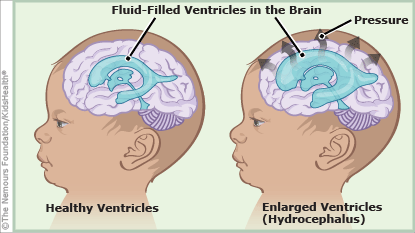
Let's first take a look at the ventricles. I showed a picture in my last post of a child with HC and the extra CSF that was present, but let's take a look at what the ventricles are supposed to look like. 

Ventricles in the brain (Wikipedia)

Here we can see the lot of internal structures that are present in the brain. The blue is where the CSF flows inside the brain. Remember that CSF's job is to bring nutrients to the brain. 

ventricle comparison (Wikipedia, CDC)

Now what happens when too much fluid builds up in the brain? Well with the increase in fluid comes and increase in pressure. In an infant the head can swell because the skull bones are not all fused, but this does not free them from the damaging effects of increased pressure. Slight to severe learning difficulties can be present in infants who have treated HC, but research on adults who had had shunts placed within their first year of life have been promising, showing that they may present with learning difficulties without having an overall impact on intelligence or functioning. (Lindquist, B. et. al. 2011)

This increase in pressure causes damage to the small blood vessels, the nerves, and the other structures in the brain. As the pressure increases more and more damage is caused. Time is of the essence with Increased ICP. The sooner the pressure is relieved the less damage and risk for complications there will be. 

That raps up this post. Next we will be diving in to the diagnostic measures, and how docs go about determining what is causing the HC. 


https://en.wikipedia.org/wiki/Ventricular_system#/media/File:Blausen_0896_Ventricles_Brain.png
https://en.wikipedia.org/wiki/Hydrocephalus#/media/File:Hydrocephalus_CDC.png

Lindquist, B. et. al. (2011). Very Long term follow up of cognitive function in adults treated in infancy for hydrocephalus. Child's Nervous System. 27 (4) pp. 597-601 retrieved from: http://link.springer.com/article/10.1007/s00381-010-1311-y

Some People Are Born With a Big Head

This post is about answering the questions "Where?", "Who?", and "How Often?" in regards to the population it affects.

Because Hydrocephalus (which I will now be abbreviating HC) is not a standalone disorder it does not have precise statistics. According to a Medscape article covering the surgical methods used to deal with HC (which we will go into later) when you take into account spina bifida in regards to it have a high chance of HC the incidence is about 2-5 per 1000 live births. Congenital HC also only includes a small portion of potential HC cases. The leading factors of non-congenital HC include head trauma, neuro tumors, intracranial hemorrhage, and infections in the brain. (Medscape, 2015)

Shows what HC might look like in an older child with sutures fully closed
It hard to explain the picture (Medscape, 2015) without being able to point at your screen for you but I will try. See the dark wobbly line between the brain and the skull? That is filled with extra fluids. Also in the very center the black spot there is part of the brain's ventricles, and usually it does have CSF there and is black, but it is not normally that large and swollen looking, as well as just below it near the cerebellum. 

According to the CDC in the United States about 1,500 babies are born with Spina bifida a year, which can often include HC. Health care costs can be quite high for these individual ranging from a couple thousand to well over a million dollars in the child's first year of life. (CDC, 2015). Spina bifida also appears to affect Hispanics more often than it does those of Caucasian or African decent. Lastly, according to research by John Hopkins Medical Center unterated hydrocephalus has a 50-60% mortality rate, but if the children survive after their first year of treatment most will go on to live a full life span. (John Hopkins, r.2016)


That raps up this post. Tune in next time as we tackle the pathophysiology of the disease, where we will see how and what damage it may cause and what that might affect in an individual. 


CDC, 2015. Data and statistics, spina bifida. retrieved from: http://www.cdc.gov/ncbddd/spinabifida/data.html
John Hopkins, Retrieved 2016. Hydrocephalus. retrieved from: http://www.hopkinschildrens.org/hydrocephalus.aspx
Medscape, 2015. Neurosurgery for hydrocephalus. retrieved from: http://emedicine.medscape.com/article/247387-overview#a7

Sunday, January 24, 2016

It's All In Your Head

Foreword: This blog will be for a senior level Bachelor's of Nursing course. It is intended to offer a look at a disease in a way that will be able to be understood by most, while still offering depth into the medical complications of such an issue. All information will be gleaned from textbook, lecture, and research sources. This is a medical blog, images presented may not be suitable for all audiences but it will be kept clean and show images from an objectively medical, educational, and professional standpoint. Any questions may be directed at the author and attempts will be made to answer them. 

HYDROCEPHALUS

Hydrocephalus, the literal translation is Hydro-"Water" in the Cephalus-"Head". It is a condition that occurs when too much Cerebrospinal fluid builds up in the ventricles in the brain. Cerebrospinal fluid, commonly called CSF, is the "brain juice" that flows around and inside your brain as well as down your spinal cord. It consists mostly of water and sugar along with other brain and nerve-essential nutrients. The issue of hydrocephalus arises when either too much fluid is being created or the fluid cannot be disposed of as quickly as it is being made.


Hydrocephalus is not normally a standalone defect, it is usually accompanied by other complications such as nervous system defects such as spina bifida or neural tube defects, or with malformation of the brain. This can also be caused by external complications such as intrauterine infections during pregnancy and birth.

Hydrocephalus is most often seen in newborns or infants (but it can be seen in older children) because the sutures of the skull are not fully sealed and still possess some pliability. This allows the cranial cavity to expand and accommodate the increase in fluids.

Sutures in the Infant Skull


Hydrocephalus is damaging to the brain due to the increased Intracranial Pressure (ICP), but it can be corrected. There is no true "cure" but shunts can be put in place to relieve the excess fluid and lower the ICP. This will be discussed in further detail in future posts, but it can be done to allow a normal life to be lived for those affected by Hydrocephalus.

That's all for this weeks blog. Check back next week as we dive in to tides teeming with knowledge.


Sources: Google Image search results:

1 http://www.rchsd.org/wp-content/uploads/kidshealth/images/image/ial/images/3252/3252_image.png
2 https://myhealth.alberta.ca/Health/_layouts/15/healthwise/media/medical/hw/h9991915_001.jpg
3 http://www.wallpaperez.org/wallpaper/movie/Megamind-2079.jpg

Ricci, S. (08/2012). Essentials of Maternity, Newborn, and Women's Health Nursing, 3rd Edition. [VitalSource Bookshelf Online]. Retrieved from https://coursepoint.vitalsource.com/#/books/9781469884370/